JOURNAL OF THOMAS NICKERSON—Keeper, Merrow Point Lighthouse
Appointed: 14 March
19 March
“You cannot swim for new horizons until you have courage to lose sight of the shore.”
—William Faulkner
I note, with no small degree of pride, that I have lost sight of the shore. Six days at Merrow Point and I find myself wondering why it took me this long—why any of us endure the noise and crowding of the world when this exists. The rock. The light. The absolute, clarifying simplicity of a single necessary task performed in sublime isolation.
The previous keeper left things in good order, for which I’m grateful, though their reading material leaves something to be desired. Three spy thrillers, a tide table and an issue of Lloyd’s List from 2012. I’ve shelved my own books alongside and already the room feels properly inhabited.
The light itself is extraordinary. Automated, yes—my role is maintenance and record-keeping rather than anything so romantic as manning the lamp—but at night, watching the beam sweep the Atlantic, I feel the not inconsiderable satisfaction of a man who has finally put himself in the right place.
4 April
Supplies came Tuesday. Tinned soup, fresh batteries—the torch has been consuming them at an unreasonable rate—two paperbacks I’d requested and a letter I will address at a later time.
The rock has extraordinary acoustic properties. The cave system below the station conducts the tide in curious ways; there is a low sort of hum that I’ve begun to notice at irregular intervals. It resonates quite distinctly in the walls of the lamp room. Remarkable, really. I’d not anticipated the geology being quite so present.
I dreamt last night of a woman on the stairs. She was dripping seawater onto the iron steps. The sound ᝰᜑ
h̑eͦrͬ ḟ̠ȃ̗c̚e̷̯
I woke before the top of the stairs, which I note primarily because the dream had a vividness I associate with poor sleep. The harmonic from the cave system must be affecting me more than I’d expected—sound at particular frequencies is well documented to disturb sleep architecture.
I’ve ordered earplugs with the next supply run.
The two new paperbacks are excellent. The soup less so.
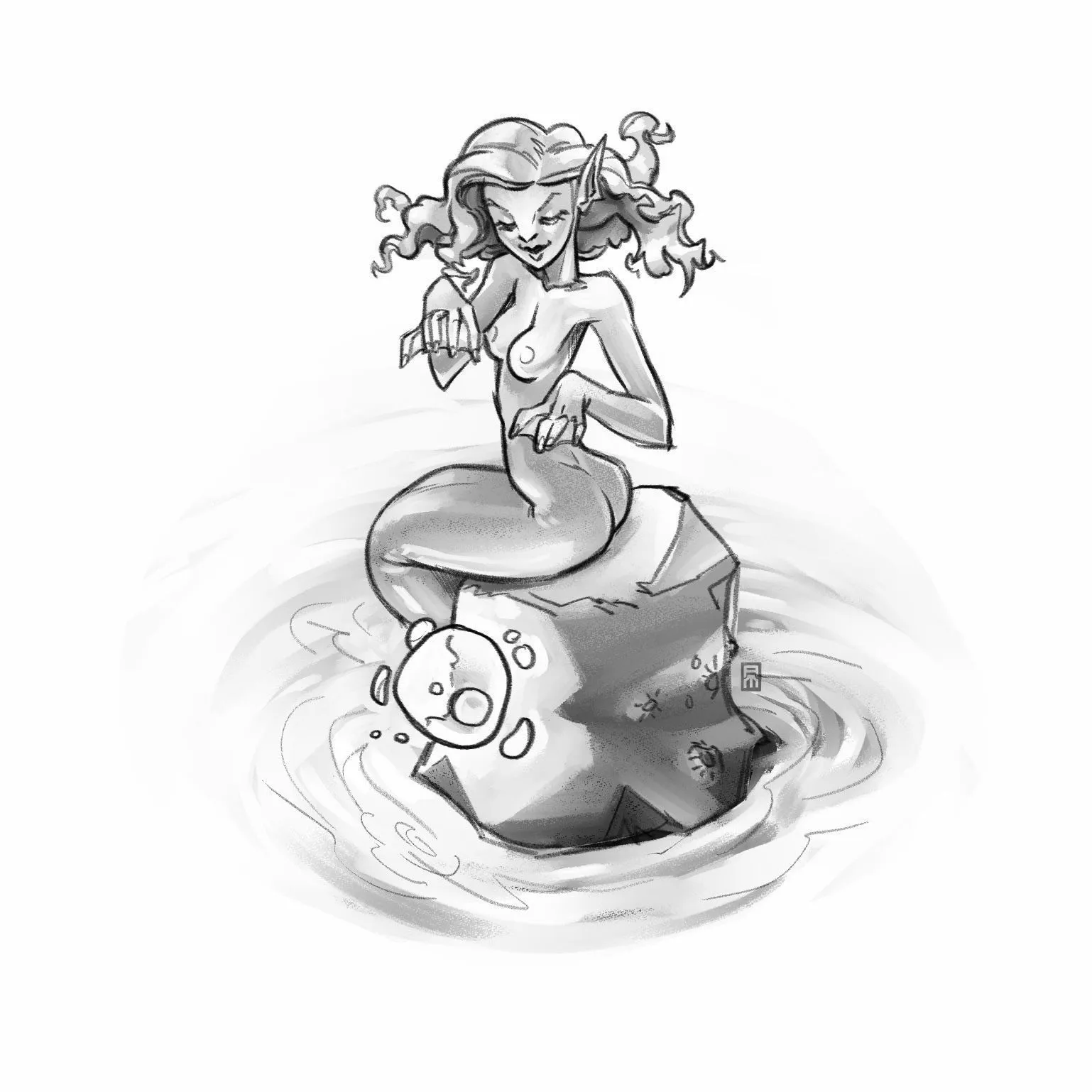
The lamp sweeps. In the light: a woman on the equipment housing, watching him with luminous amber eyes.
In the dark: the sound of the Atlantic, sixty feet below.
Thomas stands motionless in the doorway, and his mind, which has never once in thirty-eight years stopped producing commentary, is silent. The rotating beam comes around again. She is still there. Raven-coloured hair plastered against her collarbone. Oddly pointed ears. Full breasts, nipples drawn tight in the cold air. Her scaled hips catching the light and throwing it back transformed—grey-green to silver to a colour that he names ‘red’.
Her tail hangs over the edge of the housing, moving lazily.
She makes a sound.
It isn’t language, but it is shaped like a question. Thomas’s body answers—a loosening across his shoulders, warmth flooding his abdomen—and he watches himself cross the lamp room floor.
 This is a dream, he thinks.
This is real, he thinks.
Her hand, when she places it flat against his sternum, is like ice. The fingers are too long. The palm is faintly textured, and Thomas can feel his own heartbeat through it.
This is the most intimate thing that has ever happened to me, he thinks.
She spreads her fingers wider. The lamp sweeps.
In the dark: she sings.
It starts below hearing, in the rock, in the iron walls, in the fillings of his back teeth. As the frequency lifts, Thomas begins to truly see. The rehearsed arguments stop first. The catalogued regrets. The letter he didn’t answer and his novel, sitting almost finished for two years, and the soft, background shame he carries about both. These things become, very suddenly, extraordinarily uninteresting.
What remains is Thomas, without all that. He is surprised by how much of him is left.
His hands find her without instruction. She is cool and faintly scaled even on her torso, and where his warmth meets her skin the ‘red’ becomes a glow. It’s not red, of course, it’s her song. She makes a low, satisfied sound against his throat, and her tail coils around his hips with a strength that should terrify. It does not.
Her too-long fingers find his waistband. They strip him with an efficiency that briefly resurrects Thomas’s self-consciousness—he is a thirty-eight year old academic in a raincoat on a rock in the Atlantic—and then she wraps her cool fingers around his cock and any nervousness evaporates.
The lamp sweeps.
She strokes him slowly and those strange eyes focus on his face. He is fully hard—bordering on painful—and the slick chill of her grip and the heat of his own blood is a sensation he cannot name. Her thumb traces around the edges of his tip and Thomas makes a brand new sound.
She smiles.
Thomas looks at that mouth—those teeth, hair-thin, row on row, nothing at all human about them—and wants to kiss her more than he has wanted anything.
She draws him toward her by his cock, and guides him against the join of her tail where her scales shift and part, where she is warm and wet, not from seawater. When he glides into her warmth the song spikes—a single high ’note’ thrumming through the base of his skull—and Thomas’s hands grip the equipment housing like a drowning man holding a life-preserver.
Her tail coils tighter. It is immensely strong. It sets the pace, one that is hers entirely, and Thomas understands with exceeding clarity: he is not a participant, he is an instrument being played. The understanding doesn’t bring humiliation; he is bathed in a profound relief.
She rolls her hips. He gasps. She does it again, slower, watching his face, and the song rises and rises and he is moving with her now, into her—pussy?—the heat inside of her, the cold of her scales against his thighs, her nails raking his back.
She lowers her head to his shoulder and he feels the needle teeth graze his skin—not breaking it, just reminding him—and the sensation rockets through him.
Twice she brings him to the edge and withdraws the song. It is a receding tide. He sags against her both times, shaking, sweat-damp and half-frozen and barely coherent, and both times she makes a sound—amusement—while her tail holds him fast, her hand working him slowly back down to something merely unbearable.
Please, Thomas says, or thinks, or the word only exists between them.
The third time she doesn’t withdraw.
The song gives him permission. The song commands.
Thomas’s hips slam forward once, twice, helplessly, and then he is coming with a force that whites out the lamp, the cold, the Atlantic, the letter, the book, the last two years—all of it gone, all of it irrelevant, his voice ragged and his hands gripping the equipment housing and her name—Thessaly—arriving in his mind like a rogue wave, enormous and dark.
Stillness.
The lamp sweeps over a man sitting on the iron floor, back against the equipment housing, hands open in his lap.
Thessaly is at the gallery window. She looks back once.
She slips off the rail.
JOURNAL OF THOMAS NICKERSON—Keeper, Merrow Point Lighthouse
Undated
- she came bak
- the windw is open
CCGS Private LeHave VC
Department of Fisheries and Oceans
Incident Classification: Keeper Wellbeing—Unscheduled
Merrow Point Lighthouse—Station Report
Attending Officer: M. Chouinard
Date of Inspection: 17 April
Station found in satisfactory operational condition. Light functioning within normal parameters. Station log current to 14 April. Keeper quarters tidy. No signs of forced entry or structural damage.
Keeper T. Nickerson was not present at time of inspection.
Personal effects remain on site. No indication of voluntary departure. Supply vessel C236596QC Les Douces Profondeurs confirmed presence of Nickerson, no passengers taken on, 11 April.
The following items were noted and/or retained for administrative purposes:
- Personal journal, recovered from lamp room floor, most recent entry undated
- One ceramic mug, contents cold, unspoiled
- Lamp room gallery window found open
- Search of rock and shoreline conducted, Nickerson not located
No further findings.
File referred to RCMP detachment, Lunenburg, NS